

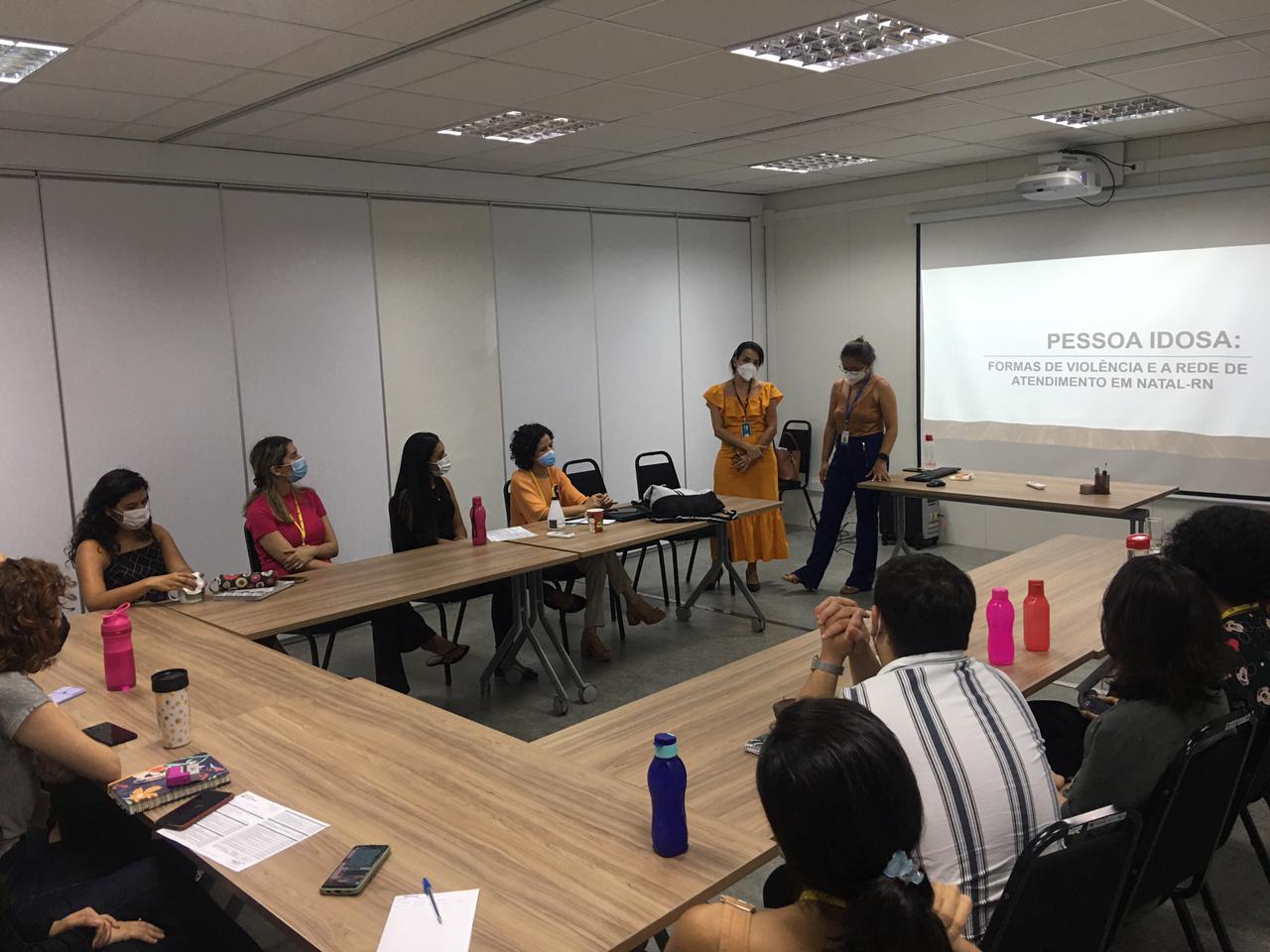
During the week of World Elder Abuse Awareness Day, the Santos Dumont Institute (ISD) hosted the lecture “Elderly people: forms of violence and the care network”, given to students of the Multiprofessional Residency in Health Care for People with Disabilities by the social worker and coordinator of the Single Registry in Natal/RN, Daniela Medeiros, this Monday (14).
According to Daniela, there are numerous types of violence against the elderly, and they can be visible or invisible. “Violence against the elderly can take many forms and occur in different situations. However, for different reasons, it is impossible to measure its full scope, as it is underreported. The visible types are deaths and injuries, while the invisible types are those that occur without causing bodily harm, but cause suffering, hopelessness, depression and fear,” she explains.
This Tuesday (15), World Elder Abuse Awareness Day is celebrated. The date was recognized by the United Nations General Assembly in 2006, following a request from the International Network for the Prevention of Elder Abuse (INPEA). The idea is that on this day the entire world will express its opposition to abuse and suffering inflicted on older people.
For multidisciplinary preceptor and social worker Renata Rocha, violence against the elderly is a cross-cutting issue that is inherent to the work of providing healthcare to people with disabilities. “We discuss the elderly in psychology, physiotherapy, social work, nursing, speech therapy, and in various areas of practice. Many of Anita’s patients are elderly, as is the case with patients at the Parkinson’s, Audiology, and Physical Rehabilitation Clinics, and it is very important that everyone is aware of these issues related to the elderly, the types of violence, warning signs, and the care network to know what type of care that person should receive,” she said.
VIOLENCE
Physical and psychological violence, neglect, abandonment, financial abuse, patrimonial violence, sexual violence and discrimination. There are several types of rights violations that elderly people can suffer, with psychological violence, abandonment and neglect being the most frequent, according to the social worker.
Psychological abuse practiced through acts such as verbal aggression, treatment with contempt, disdain, or any action that causes emotional suffering such as humiliation, removal from family life or restriction of freedom of expression; as well as subjecting the elderly person to conditions of humiliation, offenses, negligence, promoting insults, threats and gestures that affect the self-image, identity and self-esteem of the offended party, is considered psychological violence and is a crime punishable by detention.
Negligence is the refusal or omission of care, and abandonment is a form of violence that manifests itself in the lack of support or assistance by those responsible in fulfilling their duties of providing care to an elderly person.
“It is our obligation as a community to ensure that the rights of the elderly are guaranteed. And we often think that it is not here, it is not with me, it is not in my house and we do nothing, but it is the obligation of the family, the community, society, and the government to ensure that the elderly have the right to life, health, food, education, culture, sports, leisure, work, citizenship, freedom, respect, and family life,” said Daniela Medeiros.
VULNERABILITY
During the coronavirus pandemic, violence against the elderly has increased in Brazil. According to figures from Disque 100, the Ministry of Women, Family and Human Rights, in the first half of this year alone, more than 33,600 reports of violations of the rights of the elderly were registered. Throughout 2020, there were 48,500 cases. Last year, between March and June, right at the beginning of the pandemic, the number of reports increased by around 59% compared to the same period the previous year.
COMPLAINTS
Social assistance to the elderly is provided in an articulated manner, in accordance with the principles and guidelines set out in the Organic Law on Social Assistance, the National Policy for the Elderly, the Unified Health System and other relevant regulations.
The channels for reporting cases of violence against the elderly include Disque 100 and the Human Rights app, available free of charge on the internet. Reports can also be made at the Specialized Police Stations for the Protection of the Elderly. If the municipality does not have a specialized police station, it is possible to go to any police station.
The website of National Ombudsman for Human Rights is another channel where you can report. State or municipal councils for the Rights of the Elderly and the Public Prosecutor's Office also receive reports of mistreatment of the elderly. You can also call 190 (the Military Police telephone number for situations of imminent risk) or 192 (to call for urgent help, when applicable).
Text: Kamila Tuenia – Journalism Intern / Ascom – ISD
Photograph: Kamila Tuenia / Ascom – ISD
Communication Office
comunicacao@isd.org.br
(84) 99416-1880
Santos Dumont Institute (ISD)
It is a Social Organization linked to the Ministry of Education (MEC) and includes the Edmond and Lily Safra International Institute of Neurosciences and the Anita Garibaldi Health Education and Research Center, both in Macaíba. ISD's mission is to promote education for life, forming citizens through integrated teaching, research and extension actions, in addition to contributing to a fairer and more humane transformation of Brazilian social reality.