

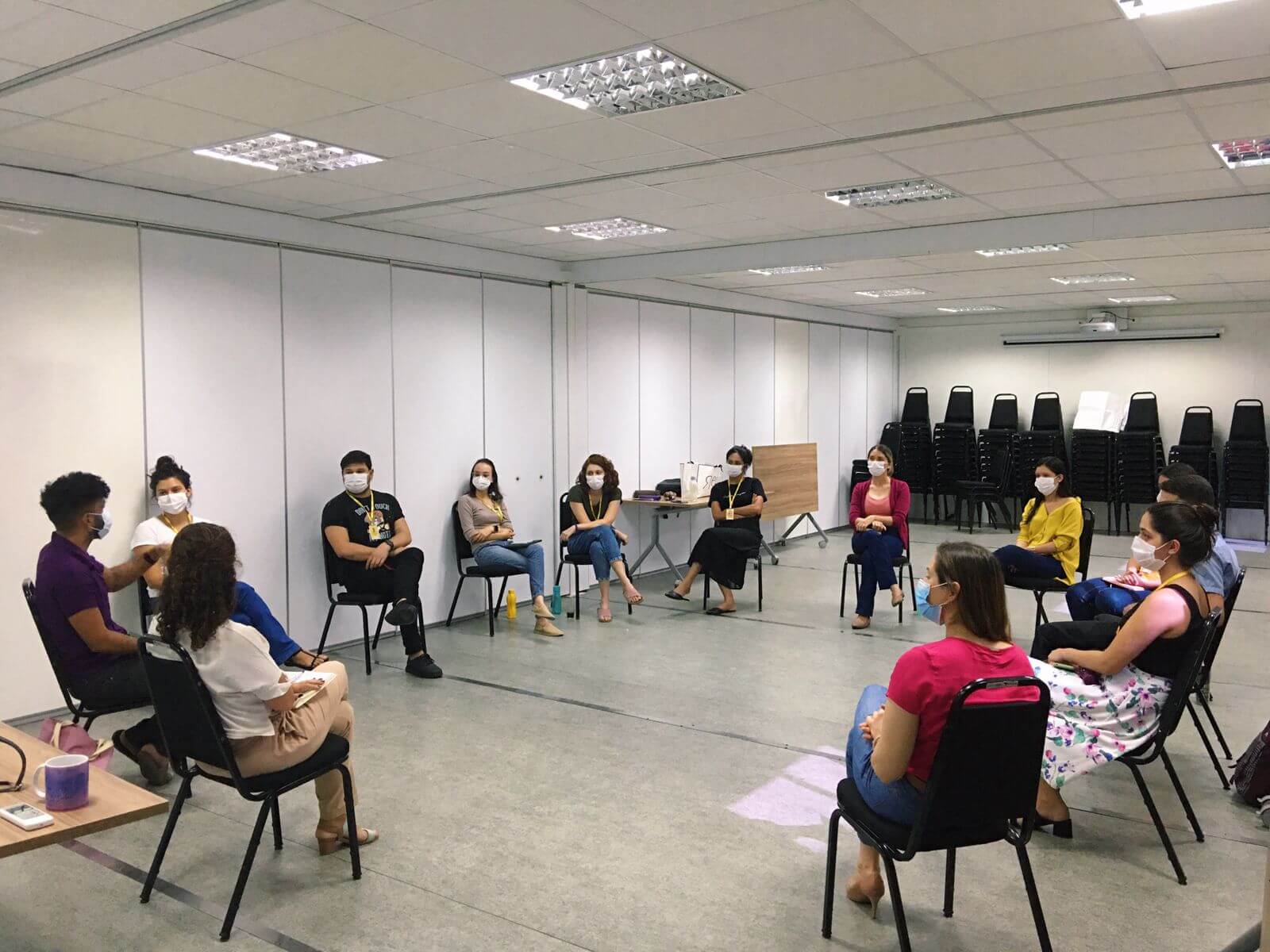
How to welcome a person culturally different from you in health care? This Thursday (August 19) students from the Multidisciplinary Residency in Health Care for Persons with Disabilities began classes in the Cultural Competence discipline, which aims to discuss the embracement in the health area of the diversity that can be found in serving the population.
Cultural competence, according to medical preceptor Carolina Damásio, who teaches the discipline, is the recognition of the cultural characteristics of social groups and their different needs in the care process. “It's everything a professional needs to assist someone culturally different from him, especially in caring for people with disabilities. Empathy, sensitivity and the understanding that each person has their own history, culture, religion and that the things that the patient believes are not the same as what we believe”, he explains.
The discipline is taught by Carolina and also by the physiotherapist and coordinator of the Residence, Lorenna Santiago, and aims to develop in residents the skills necessary to ensure adequate and culturally sensitive care is aimed at people with disabilities, for people of different ages, genders, sexual orientations , ethnicities and regions.
“A case that we always comment on in this discipline is when the professional only addresses the caregiver at the time of the consultation, when it is a person with a disability, for example, if it is an adult, one should not ignore his presence there and yes, if you go to him, ask questions and explain the treatments and procedures correctly”, said Carolina Damásio.
art and disability
The class that marked the beginning of the discipline this semester had the participation of Gira Dança's artistic director, Alexandre Américo, who addressed the cultural notion of the body and the relationship between art and disability. The Potiguar contemporary dance company, made up of people with and without disabilities, seeks to deconstruct normative standards in the artistic field.
For Alexandre, art and disability can and should be related. “We think about deconstructing that when talking about a dancer, people think of someone with a standard body. Our company is made up of people with and without disabilities, we work non-normatively, there are people with visual impairments, physical disabilities, down syndrome, white people, black people, fat people, thin people and this makes us understand the individualities of each one, as it should be in health practice, he says.
Text: Kamila Tuenia / Ascom – ISD
Photograph: Kamila Tuenia / Ascom – ISD
Communication Office
comunicacao@isd.org.br
(84) 99416-1880
Santos Dumont Institute (ISD)
It is a Social Organization linked to the Ministry of Education (MEC) and includes the Edmond and Lily Safra International Institute of Neurosciences and the Anita Garibaldi Health Education and Research Center, both in Macaíba. ISD's mission is to promote education for life, forming citizens through integrated teaching, research and extension actions, in addition to contributing to a fairer and more humane transformation of Brazilian social reality.