

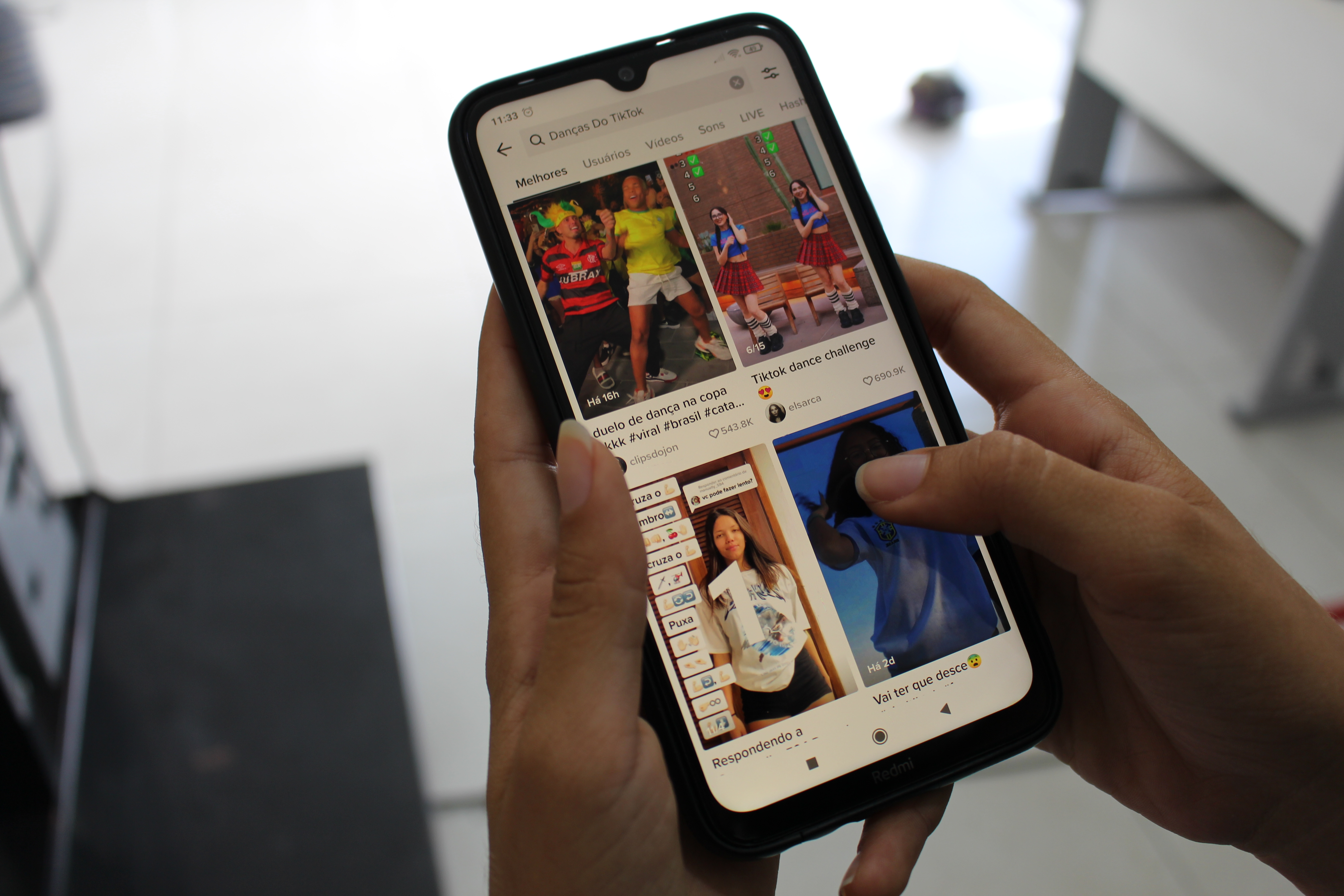
In recent years, trends have been increasingly engaging children and teenagers, with the appeal of being the “new fad” of the moment and a way for this audience to socialize. Trends are viral content, which can be dances, performances and dubbing, covering a variety of topics. Although harmless in many cases, the new fad should also be followed by parents and guardians, given some challenges that pose risks to the physical and psychological health of those who practice them.
One example of this is the “deodorant challenge,” which encourages a competition to see who can inhale the largest amount of aerosol deodorant for the longest period of time, and led to the deaths of two young people in 2022, in Pará and Minas Gerais. Health professionals warn that it is important for those responsible to be aware of this type of content, which is harmful to the well-being of users, especially during the development phase of childhood and adolescence.
According to Marta Alves, a psychology preceptor at the Santos Dumont Institute (ISD), there are trends that engage and entertain users and go viral on social media in a harmless way. However, there are also those that are popularized and replicated by children and adolescents without them being able to realize or reflect on the consequences and repercussions of that.
According to the psychologist, this is not the first time that internet challenges have resulted in real consequences. She cites as an example the “Blue Whale Challenge”, which went viral in Brazil and other parts of the world in 2017, as it was linked to multiple cases of self-harm among children and adolescents. More recently, in 2022, experts also raised warnings about a challenge that encourages young people to simulate the act of “smoking” a cotton swab, inhaling the tip of the object's shaft, a practice that can cause short- and long-term complications.
“For this generation that grew up with access to technology, many things are only seen as possible if there is screen mediation, so exposure is inevitable. But both high exposure and the content consumed can harm a child’s development. So it is important for those responsible to know that it is necessary to establish rules and limits regarding this use,” explains the psychologist.
Building the rules
According to Marta, even with the recommendation that those responsible establish limits on the use of networks, to achieve an ideal and healthy scenario in the use of the internet, they must be based on two important points: openness to dialogue and clarity about the reasons for the rules.
“There are strategies for adequate control of what is being consumed there, but everything varies from person to person and from family to family, it is relative. The important thing in all cases is that parents and guardians understand that it is necessary to gradually build these rules, always making it clear to the child why what is being done is being done. Over time, the child will not need the rules, because they will understand the reasons”, he emphasizes.
According to the psychologist, this mediation aims at a “turning point”, that is, the moment in development when, from childhood to adolescence, children begin to become more autonomous and more aware of what they do and why.
That is why it is essential that, from an early age, there is an understanding of the child's autonomy and freedom of choice and expression, but also of how far this autonomy can go. It is necessary to understand what needs to be limited at each age group, and what the child or adolescent already has the discernment to do.
One example of this, says Marta, is clothing. After a certain age, children should have the freedom to choose what to wear. However, when it comes to, for example, a school uniform, parents and guardians know that there is no way to choose a different outfit. At this point, they should explain to the child why this rule exists, setting limits on something that until then, for the child, would be a free choice.
And this is how it works with the internet. If it is not feasible to completely cut off access for minors, considering all the facilitating functions that technology provides, it is possible and recommended that there be a limitation on how far this access can and should go.
“It is very important to create a culture of open spaces for dialogue between parents and children at home. Work with children to identify what is and is not dangerous, provide spaces for questions, help them understand what stage of development the child is at and what works to implement in this family culture,” says Marta.
The role of the health professional
One of the most essential aspects of the family-centered care model is the active participation of healthcare professionals in homes. For Marta Alves, this model should also be adopted in mental health care and in building healthy habits for children and adolescents, including what is consumed and done virtually.
“The role of health services and professionals is precisely to work together with parents and guardians to create these spaces for dialogue, to build an environment that allows children to ask questions and seek help at home,” he explains.
The psychologist emphasizes that there is still a stigma regarding seeking a psychologist as a family advisor. Counseling is a practice that Marta considers important in the process of greater dialogue and understanding between parents and children.
“Seeking professional guidance does not need to be routine, only at the family’s request. But parents need to know that psychologists are available to help their children’s development,” adds Marta.
Text: Naomi Lamarck / Ascom – ISD
Photograph: Naomi Lamarck / Ascom – ISD
Communication Office
comunicacao@isd.org.br
(84) 99416-1880
Santos Dumont Institute (ISD)
It is a Social Organization linked to the Ministry of Education (MEC) and includes the Edmond and Lily Safra International Institute of Neurosciences and the Anita Garibaldi Health Education and Research Center, both in Macaíba. ISD's mission is to promote education for life, forming citizens through integrated teaching, research and extension actions, in addition to contributing to a fairer and more humane transformation of Brazilian social reality.