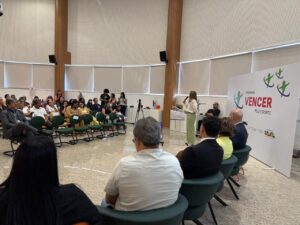


In 2017, the Belly Project, developed by Anita Garibaldi Health Education and Research Center (CEPS), was awarded by Pan American Health Organization/World Health Organization (PAHO/WHO) and by National Health Council (CNS). O Laboratory in Innovation on Social Participation in Women's Comprehensive Health Care, proposed within the scope of the Unified Health System (SUS), chose among 22 entries, six innovative initiatives from all over Brazil to receive the honor, which was presented during the 2nd National Conference on Women's Health, held in Brasília-DF (Access the article about the award HERE).
At the end of 2018, PAHO/WHO and the CNS launched a publication listing the six initiatives that were awarded at the time. One of the chapters contains details about the Barriguda Project, explaining the work of interprofessional health education and the strategies for prenatal care focused on the needs identified by the community where the project is being developed. Capoeiras, located in Macaíba, is the largest quilombola community in Rio Grande do Norte and has been hosting the CEPS multidisciplinary team to carry out Barriguda since 2015. In 2018, the project was the only Brazilian initiative to be awarded in Ireland, in the “Projects that Work”, promoted by Foundation for Advancement of International Medical Education and Research (Faimer). Access the article about the international award HERE.
The book Social participation in comprehensive women's health care. Award-winning experiences in the laboratory
of innovation on social participation in comprehensive health care for women. SUS that works series, 5. is available in PDF version HERE.
Learn more about the Barriguda Project:
https://institutosantosdumont.org.br/extensao/barriguda-comunidade-quilombola/
Text: Ariane Mondo / Ascom – ISD
Photograph: Cover of the publication
Communication Office
comunicacao@isd.org.br
(84) 99416-1880
Santos Dumont Institute (ISD)
Social organization that maintains ties with the Ministry of Education (MEC) and whose mission is to promote education for life, forming citizens through integrated teaching, research and extension actions and to contribute to a fairer and more humane transformation of the Brazilian social reality.