
ISD Master's student participates in international teaching program at the University of São Paulo.

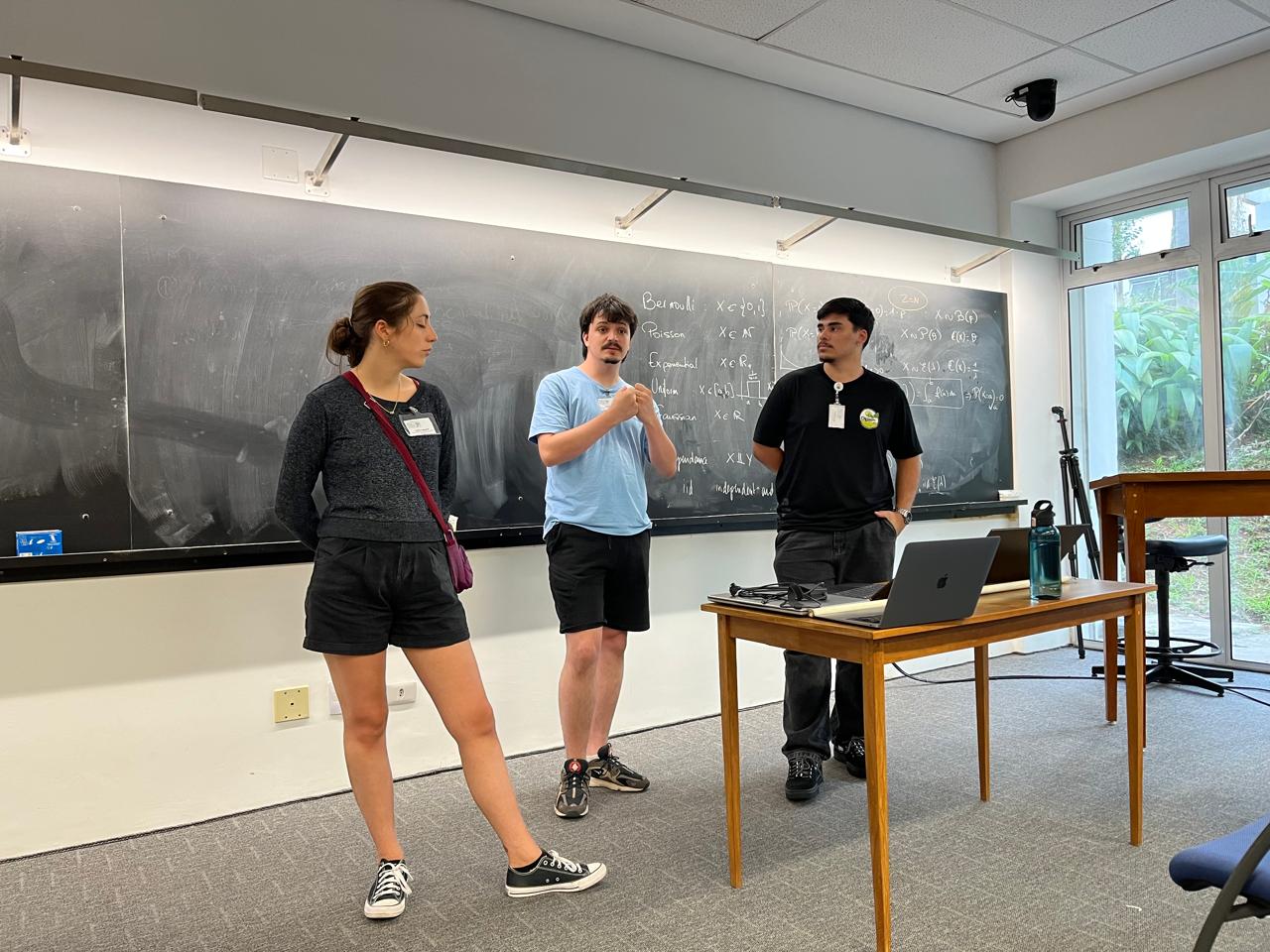
Uma foto de uma sala de aula com três pessoas em pé na frente de um quadro negro. Há uma mulher à esquerda, de cabelo preso em coque, usando blusa escura e shorts escuros, com uma bolsa tiracolo. No centro há um homem de pele clara com barba e cabelo curto, usando camiseta azul clara e shorts escuros, com o braço dobrado na frente do corpo. À direita há um homem de pele morena, cabelo curto, usando camiseta preta e calça jeans, com um crachá no peito. Na frente deles há uma mesa de madeira com um notebook aberto e outros itens pequenos em cima, além de um tripé ao lado. O quadro negro atrás tem escrita com giz, mas o texto não está legível nesta imagem.
Posted in February 23, 2026

David Meneses, a master's student in the Neuroengineering Graduate Program (PPGN) at the Santos Dumont Institute (ISD), was one of 40 students to participate in the intensive training course at the Latin American School of Computational Neuroscience (LASCON), promoted by the Research, Innovation and Dissemination Center in Neuromathematics (NeuroMat) at the University of São Paulo (USP), in São Paulo/SP. 

For one month, the student participated in theoretical classes and practical activities that addressed computational modeling of the brain. The program's curriculum covered content ranging from the study of individual neurons to large-scale neural networks. 
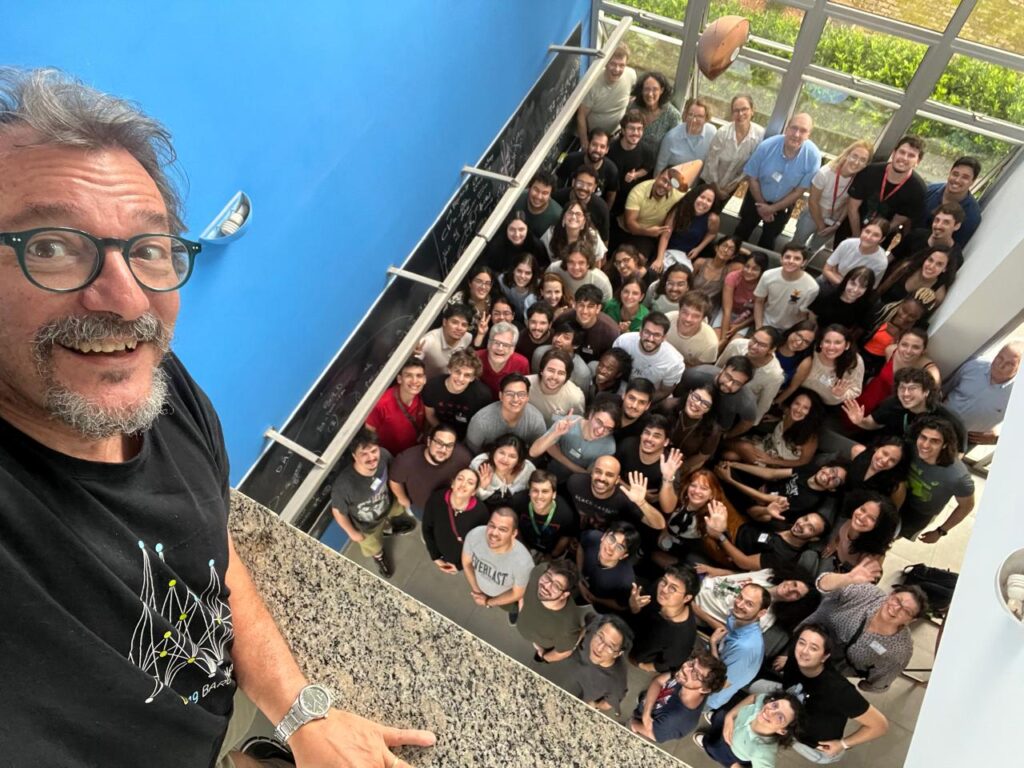
Uma foto de um grupo de pessoas. Há um homem em primeiro plano à esquerda, de pele clara, com cabelo grisalho curto, barba e bigode grisalhos, usando óculos de armação escura e camiseta escura. Ao fundo, há muitas pessoas reunidas e sorrindo, em um ambiente interno.


Among the activities performed, David highlights the practical experimentation with different tools and resources and the development of the collective research project. The project allowed students to define and solve a problem, with stages of modeling a neural system, computational simulation, and data interpretation, providing an experience similar to the flow of scientific research in the field.

"The main lesson learned during this time was to gain a deeper understanding of how computational modeling can be used as a tool for scientific research in neuroscience. The program reinforced the importance of translating biological hypotheses into mathematical and computational models, allowing us to test scenarios that would often not be possible experimentally," says the master's student.

At ISD, David is mentored by research professor Andressa Radiske, conducting research on how fear affects decision-making processes. His master's project aims, in general, to understand the formation and modification of maladaptive memories and their impacts on decisions in contexts of risk and threat. 

Like other studies in the Postgraduate Program in Neuroengineering (PPGN) at ISD, David's master's thesis is interdisciplinary, bringing together professionals, procedures, and tools from different areas of knowledge. 

“Participating in LASCON significantly broadened my perspective on the master's program, especially by reinforcing the importance of interdisciplinarity between neuroscience, mathematics, and computer science. The experience helped solidify my interest in using computational modeling and analysis as central tools in the investigation of neural signals and complex biological systems,” says David. 

Master's in Neuroengineering

Created in 2013, the Master's program in Neuroengineering at ISD is the first and only one in the country recognized by the Ministry of Education (MEC) in this area of knowledge. Its objective is to train highly qualified professionals with interdisciplinary skills and the ability to develop scientific research and technological solutions in Neuroengineering.

The program is free, lasts 24 months, and is part of CAPES' Interdisciplinary evaluation area. Classes are held at the Edmond and Lily Safra International Institute of Neuroscience (IIN-ELS) in Macaíba, approximately 25 kilometers from Natal. All students have access to free daily transportation provided by ISD between Natal and Macaíba.

ABOUT ISD

The Santos Dumont Institute (ISD) is a Social Organization of the Federal Executive Branch, supervised by the Ministry of Education, with the intervention of the Ministry of Sport. It encompasses the Edmond and Lily Safra International Institute of Neuroscience and the Anita Garibaldi Center for Education and Research in Health, both located in Macaíba. The ISD's mission is to promote education for life, forming citizens through integrated teaching, research, and outreach activities, as well as contributing to a more just and humane transformation of Brazilian social reality.

Communication Office
comunicacao@isd.org.br
(84) 99416-1880

Share this news

Recommended

More news

ISD Master's student participates in international teaching program at the University of São Paulo.

Uma foto de uma sala de aula com três pessoas em pé na frente de um quadro negro. Há uma mulher à esquerda, de cabelo preso em coque, usando blusa escura e shorts escuros, com uma bolsa tiracolo. No centro há um homem de pele clara com barba e cabelo curto, usando camiseta azul clara e shorts escuros, com o braço dobrado na frente do corpo. À direita há um homem de pele morena, cabelo curto, usando camiseta preta e calça jeans, com um crachá no peito. Na frente deles há uma mesa de madeira com um notebook aberto e outros itens pequenos em cima, além de um tripé ao lado. O quadro negro atrás tem escrita com giz, mas o texto não está legível nesta imagem.

David Meneses, a master's student in the Neuroengineering Graduate Program (PPGN) at the Santos Dumont Institute (ISD), was one of 40 students to participate in the intensive training course at the Latin American School of Computational Neuroscience (LASCON), promoted by the Research, Innovation and Dissemination Center in Neuromathematics (NeuroMat) at the University of São Paulo (USP), in São Paulo/SP. 

For one month, the student participated in theoretical classes and practical activities that addressed computational modeling of the brain. The program's curriculum covered content ranging from the study of individual neurons to large-scale neural networks. 

Uma foto de um grupo de pessoas. Há um homem em primeiro plano à esquerda, de pele clara, com cabelo grisalho curto, barba e bigode grisalhos, usando óculos de armação escura e camiseta escura. Ao fundo, há muitas pessoas reunidas e sorrindo, em um ambiente interno.


Among the activities performed, David highlights the practical experimentation with different tools and resources and the development of the collective research project. The project allowed students to define and solve a problem, with stages of modeling a neural system, computational simulation, and data interpretation, providing an experience similar to the flow of scientific research in the field.

"The main lesson learned during this time was to gain a deeper understanding of how computational modeling can be used as a tool for scientific research in neuroscience. The program reinforced the importance of translating biological hypotheses into mathematical and computational models, allowing us to test scenarios that would often not be possible experimentally," says the master's student.

At ISD, David is mentored by research professor Andressa Radiske, conducting research on how fear affects decision-making processes. His master's project aims, in general, to understand the formation and modification of maladaptive memories and their impacts on decisions in contexts of risk and threat. 

Like other studies in the Postgraduate Program in Neuroengineering (PPGN) at ISD, David's master's thesis is interdisciplinary, bringing together professionals, procedures, and tools from different areas of knowledge. 

“Participating in LASCON significantly broadened my perspective on the master's program, especially by reinforcing the importance of interdisciplinarity between neuroscience, mathematics, and computer science. The experience helped solidify my interest in using computational modeling and analysis as central tools in the investigation of neural signals and complex biological systems,” says David. 

Master's in Neuroengineering

Created in 2013, the Master's program in Neuroengineering at ISD is the first and only one in the country recognized by the Ministry of Education (MEC) in this area of knowledge. Its objective is to train highly qualified professionals with interdisciplinary skills and the ability to develop scientific research and technological solutions in Neuroengineering.

The program is free, lasts 24 months, and is part of CAPES' Interdisciplinary evaluation area. Classes are held at the Edmond and Lily Safra International Institute of Neuroscience (IIN-ELS) in Macaíba, approximately 25 kilometers from Natal. All students have access to free daily transportation provided by ISD between Natal and Macaíba.

ABOUT ISD

The Santos Dumont Institute (ISD) is a Social Organization of the Federal Executive Branch, supervised by the Ministry of Education, with the intervention of the Ministry of Sport. It encompasses the Edmond and Lily Safra International Institute of Neuroscience and the Anita Garibaldi Center for Education and Research in Health, both located in Macaíba. The ISD's mission is to promote education for life, forming citizens through integrated teaching, research, and outreach activities, as well as contributing to a more just and humane transformation of Brazilian social reality.
Communication Office
comunicacao@isd.org.br
(84) 99416-1880

Share this news