

20/05/2016
By Luiz Paulo Juttel – Ascom ISD.
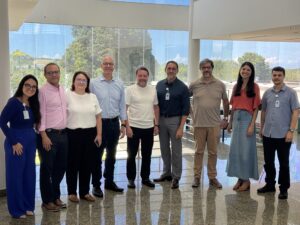
Researchers of the Alberto Santos Dumont Teaching and Research Institute (ISD) were invited by the teachers Alexander Okano It is Eduardo Bodnariuc Sources, of Department of Physical Education of the Federal University of Rio Grande do Norte (UFRN), to promote, last April, the “I International Symposium on Neuroscience, Exercise and Cognition”. The event addressed topics and research results at the forefront of knowledge in these areas and featured speakers from University of Illinois-Urbana Champaign, in the United States.
Five lectures were part of the Symposium, the first of which was a presentation on the neuronavigation system developed by the UFRN physicist, André Salles Cunha Peres. The software designed by Peres scans the brain of the patient who will receive neurostimulation sessions, marking and recording the exact 3D location of the stimulation, which can be used again in future sessions. This system will be distributed free of charge and will compete with international competitors sold at prices reaching U$ 200 thousand.
Next, the ISD researcher, Fabricio Lima Brazil, brought to approximately 130 participants of the Symposium several works carried out by the Institute in the areas of brain-machine interface and neuromodulation. These lines of research have gained prominence on the international scene by establishing direct communication between the human brain and external devices, or even modulating brain activity. Basically, this interface has two main purposes. The first is to assist patients who have suffered injuries to the neurological system and lost, for example, the movement of their limbs. The other purpose is to restore functionalities (such as movement) in an accelerated manner. These purposes are strongly connected to neuroplasticity, which is the brain's ability to reorganize its extensive network of connections between neurons, restructuring functions lost due to injuries.
Brazil demonstrated techniques that begin on the bench and end in final applications such as the manufacture and insertion of electrodes, with potential use in the treatment of patients suffering from Parkinson's, development of prostheses for use in the rehabilitation of patients who have suffered strokes (CVA) using electroencephalography (EEG), solutions for rehabilitation of limb paralysis, among other diseases.
After the ISD lecture, the North American researchers spoke, starting with Nate Ward. He presented the main results of the INSIGHT project (“An integrative system for enhancing fluid intelligence (Gf) through human cognitive activity, fitness, high-definition transcranial direct-current brain stimulation, and nutritional intervention”). Dozens of scientists came together to conduct a groundbreaking study that initially received U$ 12.7 million to develop evidence-based methods and tools capable of improving the quality of human reasoning and judgment in complex and real-world environments. These protocols incorporated the best current research in cognition, physical training, neuroscience, and nutritional interventions to enhance fluid intelligence.
Ward presented the results of studies that measured the effectiveness of products marketed as brain-training games, such as Lumosity. The studies tested the application of these games alone or in conjunction with neuronal stimulation techniques. “In isolation, playing these games did not show a significant impact on improving cognition. However, when we added neuronal stimulation, the results showed a slight improvement, depending on the intensity of the stimulation,” Ward reported.
Finally, Erika Hussey presented studies on executive control of the brain in issues related to language conflicts. Next, Alexandre Hideki Okano presented the results of research relating neuronal stimulation, exercise and nutrition. His team concluded, among numerous results, that the feeling of fatigue caused by exercise can be modulated with the use of electrical stimuli in the brain. This research was recently cited in a report in the journal Nature. International sports entities are beginning to analyze the effects of this stimulation, concerned about the emergence of what has been called “neurodoping”.
The auditorium of the Department of Physical Education at UFRN reached its maximum capacity during the I International Symposium on Neuroscience, Exercise and Cognition, with broad participation of students from ISD, UFRN and other universities. The speakers answered questions from the audience at the end of the event.