

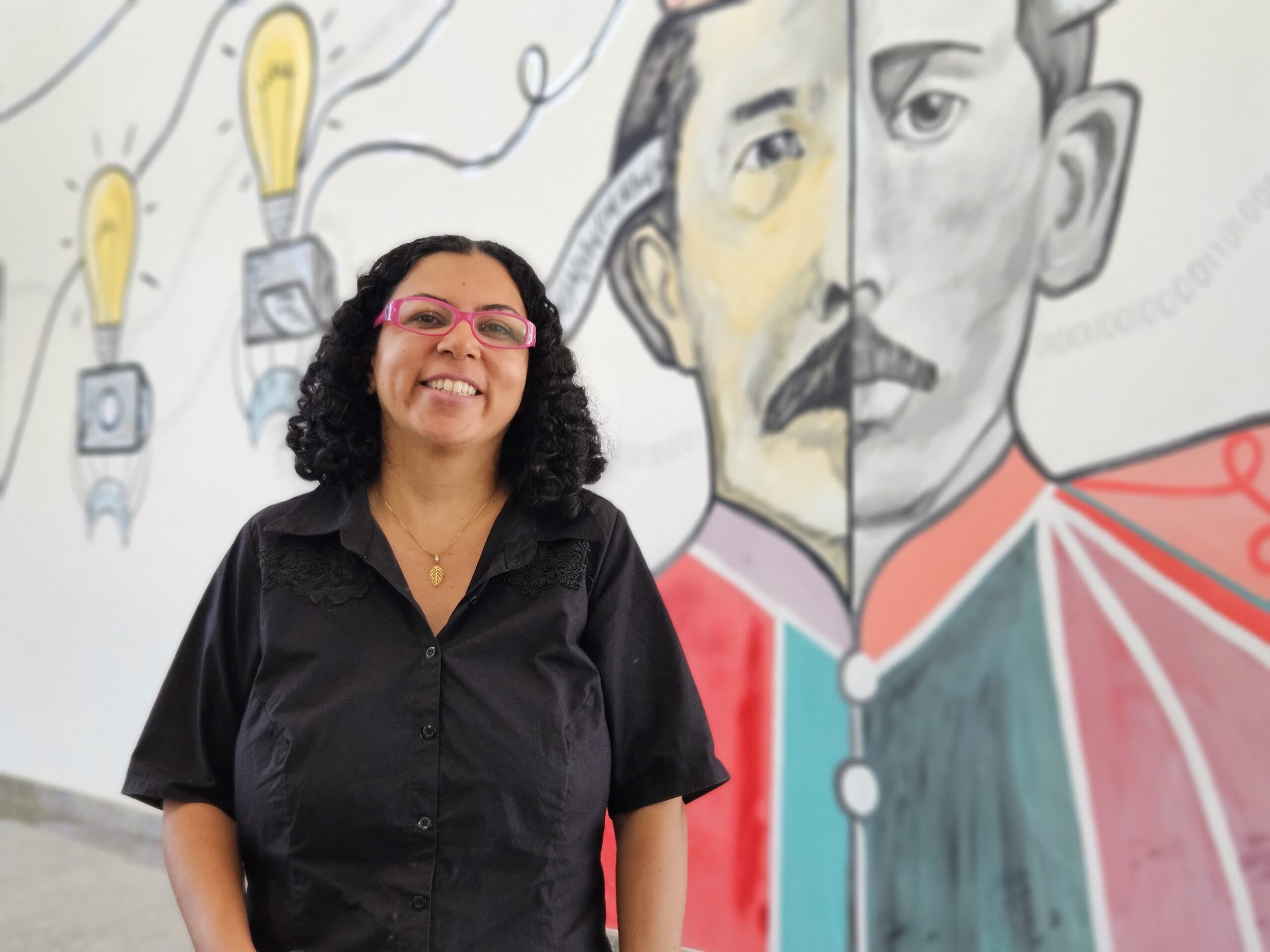
Seeing beyond one's own limits. This is the daily challenge for Dilena Mara Lemos Matos, 45. Diagnosed as a child with a vision problem that caused her to gradually lose her visual ability, the woman from Dourados, Mato Grosso do Sul, is preparing for another chapter in her academic career: studying Law at the Federal University of Rio Grande do Norte (UFRN).
Attending a university will not be new to Dilena. She has a degree in Geology from the Federal University of Mato Grosso (UFMT) and in Environmental Management from the Federal Institute of Paraíba (IFPB), in addition to a master's degree in Mineral Engineering from the Federal University of Pernambuco (UFPE). Even with all this academic experience, starting a course in another field of knowledge, at a different educational institution, generates good expectations and anxiety.
Choosing to study Law was not an initial goal. At first, Dilena thought about enrolling in Social Services, but changed her mind when she registered her Enem score on SiSU. “On the third day of registration, I realized that my score was enough to get into Law and I took a chance. Thank goodness everything worked out,” says Dilena, who filled one of the affirmative action spots for people with disabilities. In addition to the possibility of admission, she also realized that the Law course could open up new professional opportunities and opportunities to work in defending the rights of people with disabilities.
To prepare for the National High School Exam, Dilena had the help of the multidisciplinary team at the Santos Dumont Institute (ISD), a social organization linked to the Ministry of Education, located in Macaíba. For the past three years, she has been receiving care from the Rehabilitation of People with Visual Impairment line, which includes, in addition to medical ophthalmology care, training in digital assistive technology, social services and psychotherapy. “When she arrived at ISD, Dilena said she wanted to prepare for public exams and selection exams. Because she is a person with low vision, we worked with assistive technology resources for increased reading and high contrast screens, and we provided guidance on the resources for enlarged tests and assistance to readers and transcribers guaranteed by law in exams and competitions,” explains ISD’s educational preceptor, Juliana Magro.

In addition to preparing for tests, rehabilitation at ISD also helped Dilena gain greater autonomy. For example, she learned to use a cane and identify obstacles around her that could go unnoticed due to her low vision. These advances were essential for her independence in her daily life, facilitating her mobility and interaction with the environment.
What is low vision?
Low vision is characterized by a significant reduction in visual ability, even with the use of glasses, contact lenses, or other treatments. People with low vision may have difficulty performing everyday activities, such as reading, writing, and moving around, but they still have some degree of functional vision.
In Dilena's case, low vision is a consequence of toxoplasmosis acquired during her pregnancy. As a consequence of this congenital condition, the patient claims that she gradually lost her visual acuity, no longer seeing through her left eye and reducing the vision in her right eye to less than 20%.
Dilena's vision problem was identified when she was 2 years old. However, due to a lack of information and access to health services at the time, she did not receive adequate clinical and educational treatment during her childhood.
“I remember at school having to go to the board to read what the teacher was writing. My classmates thought I was just trying to show off, that I was joking. But in reality, I couldn’t see the board. At that time, no one knew how to deal with my condition,” she says.
The difficulties remain to this day, but they are overcome with effort, dedication and support from family and friends. Several agents formed and strengthened Dilena's support network along this path, from health professionals to lawyers, university colleagues and professors from the courses she attended.
“Many people helped Dilena and our family. But the most important thing is to highlight her willpower, her desire to continue and to go beyond the limits of her low vision. This condition has never prevented her from doing anything. It may have made some things difficult, but Dilena never gave up,” says Dilena’s husband, José Luís Santos da Silva.
Helping is a verb that Dilena never tires of repeating. When she finishes her law degree, she hopes to help more people with disabilities have access to justice. “I hope no one has to go through the difficulties I went through to get the basics. I want to help other people with disabilities get what is rightfully theirs,” she reiterates.
Visual rehabilitation at ISD
The Santos Dumont Institute provides free assistance to people with visual impairments through the Attention and Care Line in Rehabilitation for People with Visual Impairments, located in the institution's Specialized Rehabilitation Center (CER ISD). The initiative establishes guidance, qualification and rehabilitation strategies for people with visual impairments, with the aim of promoting quality of life and educational and social inclusion.
The target audience is made up of SUS patients of any age. Access to care is through direct referral from an ophthalmologist, with a definitive report of blindness or low vision, or through spontaneous search by scheduling a screening appointment at CER ISD.
The Line of Attention and Care in Rehabilitation of People with Visual Impairment also receives patients aged 0 to 18 years from public schools in the municipalities that make up the 7th Health Region of RN (Macaíba, São Gonçalo do Amarante, Parnamirim, Natal, Extremoz), where CER ISD is located, serving daycare centers and school levels from Kindergarten to High School.
Service
Find out how to make an appointment to access the Rehabilitation Attention and Care Line for People with Visual Impairment
Telephone numbers for scheduling: (84) 4042-0044 / (84) 4042-0033
Required documentation: SUS card; Identity document and proof of residence.
About ISD
The Santos Dumont Institute is a Social Organization linked to the Ministry of Education (MEC) and includes the Edmond and Lily Safra International Neuroscience Institute and the Anita Garibaldi Health Education and Research Center, both in Macaíba. ISD's mission is to promote education for life, forming citizens through integrated teaching, research and extension actions, in addition to contributing to a fairer and more humane transformation of Brazilian social reality.