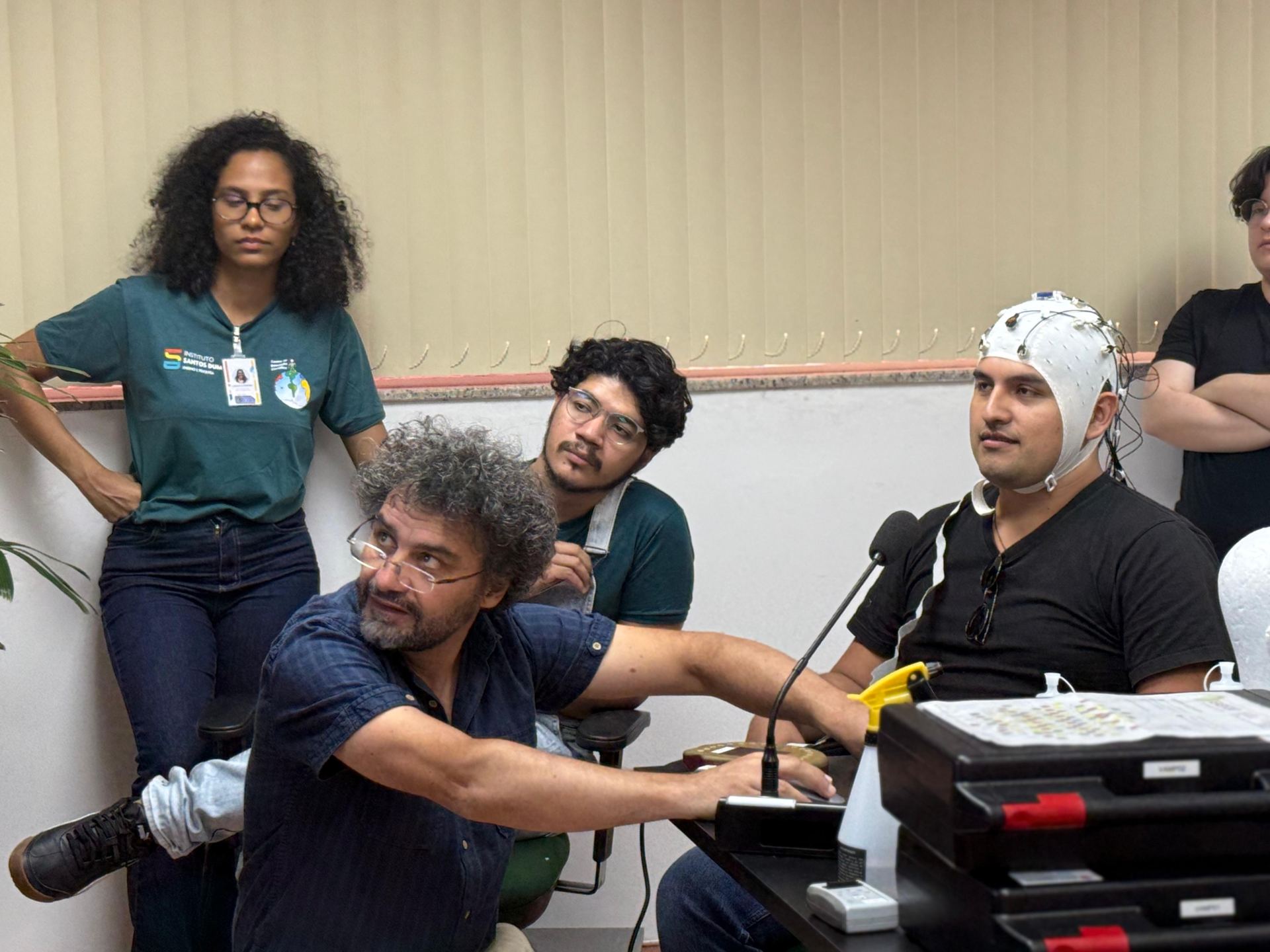


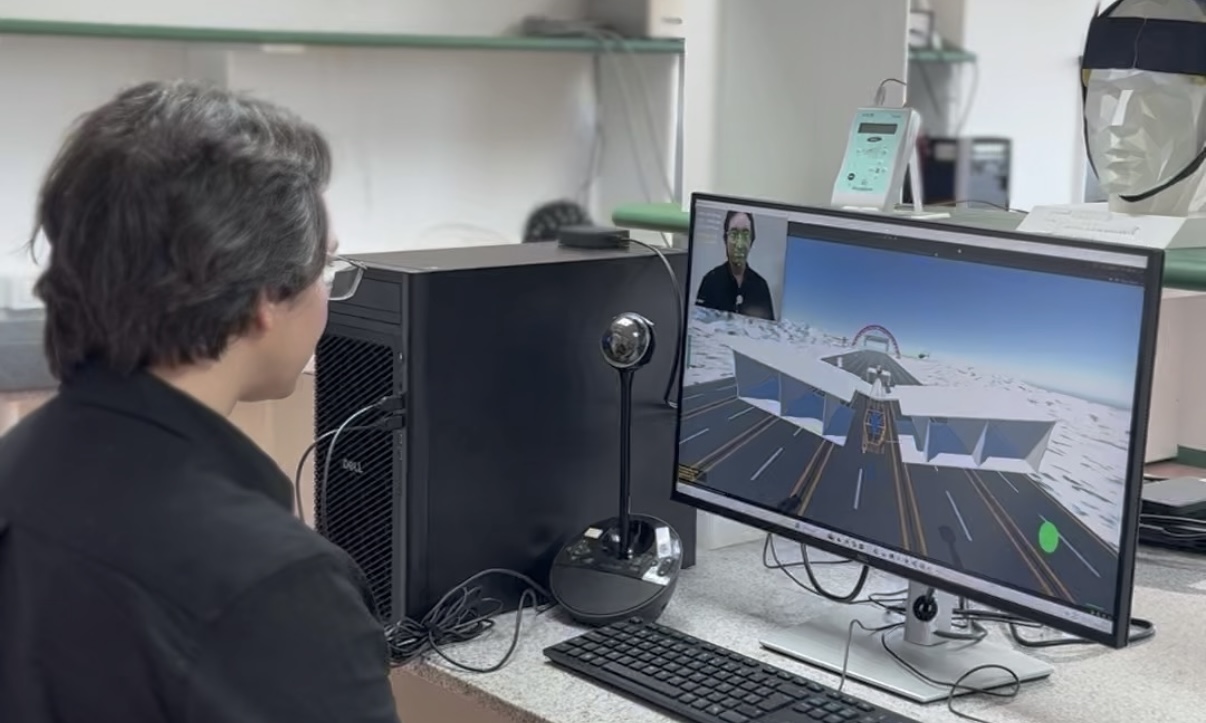
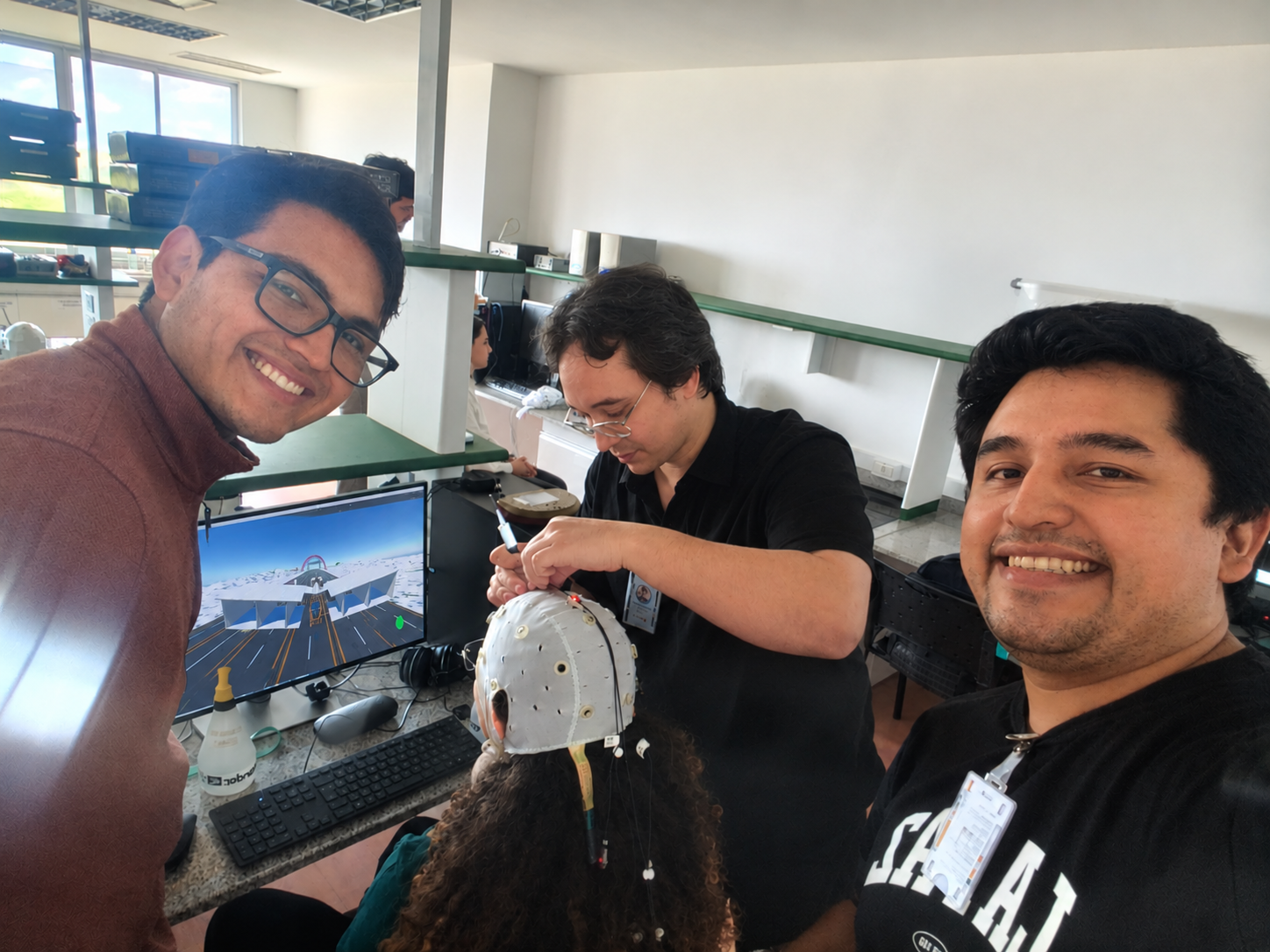
Research professors and graduate students from the Santos Dumont Institute (ISD) in Macaíba (RN), developed a game controlled by brain signals and head movements during the BR41N.IO Global BCI Hackathon, an international competition held on October 4th and 5th, 2026. In 24 hours, the team created a solution that transforms physiological signals and facial movements into commands to pilot a virtual airplane.
The team, which represented the institution in the competition, comes from different areas of knowledge and employed a multidisciplinary approach. Its members are students from the Postgraduate Program in Neuroengineering (PPGN) at ISD, Andres Ocampo and Mauricio Velez, as well as the institution's research professor, Gabriel Vasiljevic, and guest professor Leonardo Miranda.
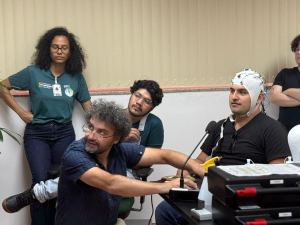
The project they developed combines knowledge from neuroengineering, biomedical engineering, and computer science to explore possibilities for interaction between the human body and digital systems. The proposal integrates two sources of information: brain electrical activity, recorded through electroencephalography (EEG), and head movements, identified from videos of the player's face.
In the game, the aircraft's speed is adjusted according to the level of attention estimated by processing EEG signals. The direction of the plane is controlled by the participant's head movements, recognized through the analysis of facial images. In this way, the player can interact with the virtual environment without relying exclusively on conventional controls.
About the BR41N.IO Global BCI Hackathon
The BR41N.IO Global BCI Hackathon brought together more than 70 teams from different parts of the world, linked to universities and research laboratories. In the category dedicated to games with brain-computer interfaces, six teams participated in the challenge, which required the creation of functional solutions within a limited time.
Brain-computer interfaces, known by the acronym BCI, from the English Brain-Computer InterfaceThese technologies allow for communication between brain activity and external devices through the acquisition and processing of neural signals. They are being investigated in various contexts, including the development of accessibility resources, communication systems, and rehabilitation strategies. In the hackathon, applying this concept to a game offered an opportunity to explore alternative ways of interacting with digital environments.
Science and innovation for the development of solutions.
Beyond technical development, participation in the competition provided an opportunity to integrate knowledge from different areas and apply concepts learned in academic training and scientific research in a practical way. The experience also highlighted the importance of collaboration in transforming scientific knowledge into technological solutions.
This initiative reinforces the potential of bringing together neuroscience, neuroengineering, and computing in creating new forms of interaction between people and machines. In Macaíba, Rio Grande do Norte, the research developed by ISD also connects to international challenges, bridging science, innovation, and technological development.
About ISD
The Santos Dumont Institute (ISD) is a Social Organization of the Federal Executive Branch, supervised by the Ministry of Education, with the intervention of the Ministry of Sport. It encompasses the Edmond and Lily Safra International Institute of Neuroscience and the Anita Garibaldi Center for Education and Research in Health, both located in Macaíba. The ISD's mission is to promote education for life, forming citizens through integrated teaching, research, and outreach activities, as well as contributing to a more just and humane transformation of Brazilian social reality.