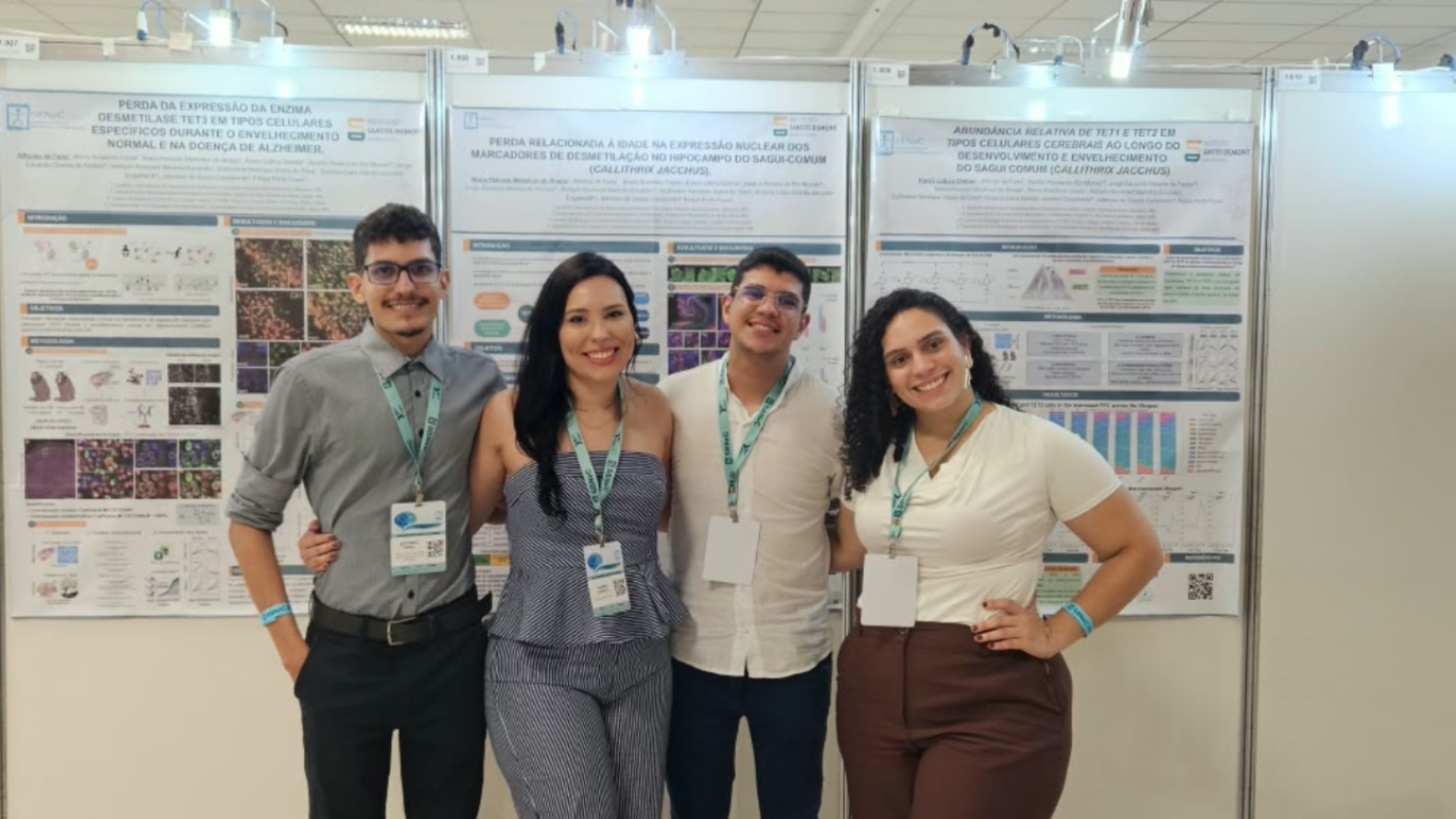



Researchers from the Santos Dumont Institute (ISD) published in the international journal Aging and Disease, a study that aimed to investigate how specific brain components and changes relevant to the functioning of the nervous system interact with cognitive decline in cases of Alzheimer's.
The research signed by Wellydo Escariao, biomedical scientist and master's student in the ISD's postgraduate program in Neuroengineering, is part of his master's research and is supervised by biologist Felipe Fiuza, a research professor at the Institute, whose main line of research is the fundamental study of the change in brain cells throughout human aging.
During Alzheimer's disease, the human body undergoes significant changes in the nervous system and the biochemical composition of the brain, contributing to cognitive changes that are reflected in classic symptoms such as memory loss, communication difficulties and the inability to perform daily tasks.
One of the central objects in the study conducted by ISD researchers, the beta amyloid protein, is the protagonist of this scenario, being one of the components that loses its natural form during Alzheimer's. In this process, these proteins begin to accumulate in plaques (called beta amyloid plaques) and this accumulation is associated with the death of neurons and worsening of the disease. To combat this phenomenon, another agent emerges: microglial cells (or microglia), responsible for the surveillance and active defense of brain tissue, which, when interacting with these plaques, produce a third agent called Plaque-Associated Microglia (PAMs).
AMPs are components that can produce different effects depending on factors such as the number of microglia and AMPs and the size of beta amyloid plaques, as well as statistical factors such as the sex and age of the person with Alzheimer's. Therefore, the published research used data obtained from the analysis of brain tissue after death, from people with and without Alzheimer's, to analyze the action and effects of these interactions in different regions of the brain.

“Our results indicate that it is not just the number of plaques or the presence of microglia that matters, but how these cells interact with the plaques, how large the plaques are and where exactly they are in the brain. These factors appear to influence the progression of the disease in different ways,” explains research professor Felipe Fiuza.
The published article is part of the work of ISD researchers in promoting and producing basic research, category of studies that seek to answer fundamental research questions on human functioning and various aspects of the world, with the aim of contributing to existing scientific theory and strengthening a basis for new treatments and technologies in the context of health and rehabilitation.
“These results help pave the way for new studies that seek to investigate in more depth the mechanisms that are acting in the cognitive decline in Alzheimer's disease and also to understand factors that can contribute to or improve the disease process,” says Wellydo.
In addition to Wellydo and Fiuza, Guilherme Silva, Hellen Castro and Sayonara Silva, graduates of the Master's in Neuroengineering, Nelyane Santana and Ramón Hypolito, research professor at ISD, are participating in the research.
The full article can be accessed in the journal Aging and Disease, at the link: https://pubmed.ncbi.nlm.nih.gov/40423635/.
About ISD
The Santos Dumont Institute is a Social Organization linked to the Ministry of Education (MEC) and includes the Edmond and Lily Safra International Neuroscience Institute and the Anita Garibaldi Health Education and Research Center, both in Macaíba. ISD's mission is to promote education for life, forming citizens through integrated teaching, research and extension actions, in addition to contributing to a fairer and more humane transformation of Brazilian social reality.