

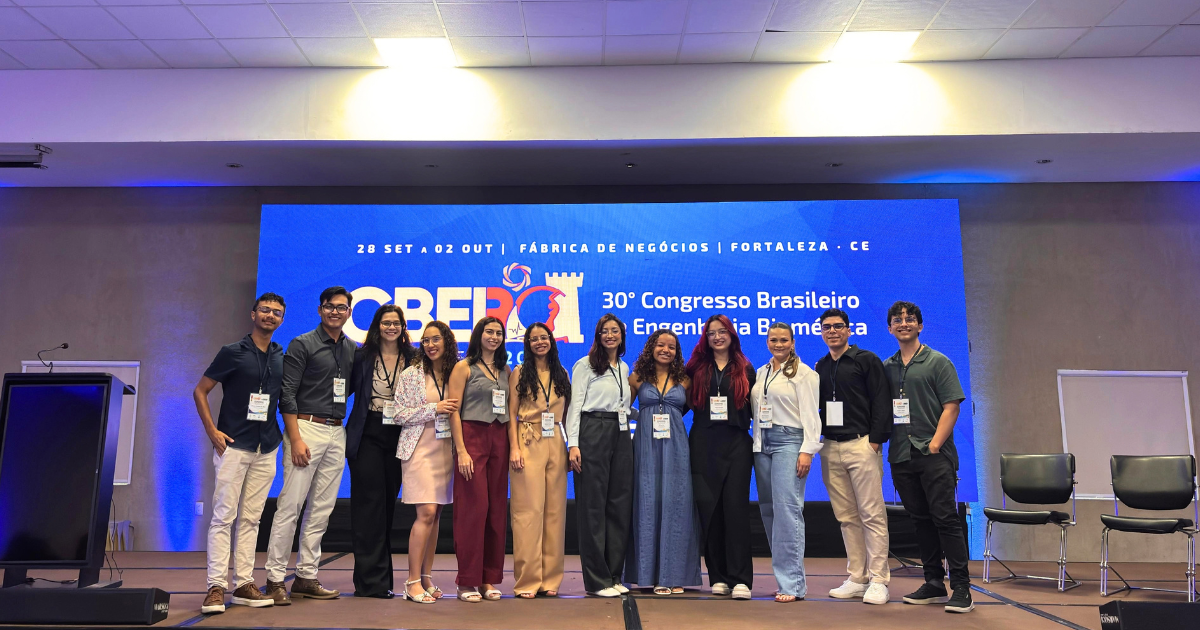
Research professors, master's students, and graduates of the Postgraduate Program in Neuroengineering (PPGN) at the Santos Dumont Institute (ISD) participated in the XXX Brazilian Congress of Biomedical Engineering (CBEB 2026), held in Fortaleza (CE) between September 28 and October 2. Promoted by the Brazilian Society of Biomedical Engineering (SBEB), the event brought together researchers, students, professionals, companies, and institutions to discuss science, technology, and innovation applied to health.
With the theme "Building Bridges between Academia and the Market," the 30th edition of CBEB aimed to bring scientific production closer to the demands of society, industry, and the health sector. The program included topics such as Neuroengineering, Artificial Intelligence, Digital Health, Biomedical Robotics, and Telemedicine, as well as activities related to innovation and entrepreneurship.
Neuroengineering, brain-machine interface and EMT
Among the ISD representatives was research professor Fabrício Brasil, who participated in different activities of the scientific program. On Monday (28), he taught the mini-course “Neuroengineering – Closing the cycle in the Brain-Machine Interface”, which addressed data acquisition techniques, brain-machine interfaces and the importance of feedback to enhance the results of these technologies.
On Tuesday (29), the researcher presented a poster with results of a study on non-invasive spinal neuromodulation in patients with depression and participated in a lecture on startups in the health area. The activity discussed regulatory challenges, business development and ways to transform academic research into applied solutions, bringing science, innovation and the market closer together.
Professor and researcher Renan Matsuda also presented a paper at the congress, bringing together tools aimed at improving the precision and accuracy of Transcranial Magnetic Stimulation (TMS), with the goal of contributing to the optimization of diagnoses and treatments related to motor functions.
Participation in CBEB also allowed PPGN students to present their research, exchange experiences, and broaden their perspective on interdisciplinary work in Biomedical Engineering.
Master's student João Victor Barbosa de Macedo presented work on cortical asymmetry in patients with Parkinson's disease and on Machine Learning applied to adaptive brain stimulation. For him, the congress provided the opportunity to connect with researchers from different fields. "Even as a physiotherapist, I was able to have a dialogue with the engineers there. This type of exchange reflects the interdisciplinary nature of the master's program in neuroengineering," he emphasizes.
Master's student Larissa de Alcântara presented research on the use of EEG signals for syllable identification based on motor imagery of speech. "Participating in CBEB was a very interesting experience, both for the opportunity to meet new people and for broadening my perspective on the diverse possibilities that biomedical engineering offers," she stated.
Training and visibility for PPGN research
The participation of research professors, master's students, and graduates of the PPGN at CBEB 2026 contributed to expanding the presence of ISD in one of the main national spaces for discussion on Biomedical Engineering and to disseminating research developed at the Institute.
Held in Fortaleza, CBEB 2026 marked the congress's return to the Northeast after 14 years. The program included mini-courses, lectures, workshops, technical sessions, and initiatives focused on entrepreneurship and innovation, reinforcing the goal of bringing academia, industry, and society closer together.
For ISD, participation in the congress represents an opportunity to share knowledge produced in the field of Neuroengineering, strengthen scientific collaboration networks, and bring together research, innovation, and the development of technologies focused on health.
About ISD
The Santos Dumont Institute (ISD) is a Social Organization of the Federal Executive Branch, supervised by the Ministry of Education, with the intervention of the Ministry of Sport. It encompasses the Edmond and Lily Safra International Institute of Neuroscience and the Anita Garibaldi Center for Education and Research in Health, both located in Macaíba. The ISD's mission is to promote education for life, forming citizens through integrated teaching, research, and outreach activities, as well as contributing to a more just and humane transformation of Brazilian social reality.