

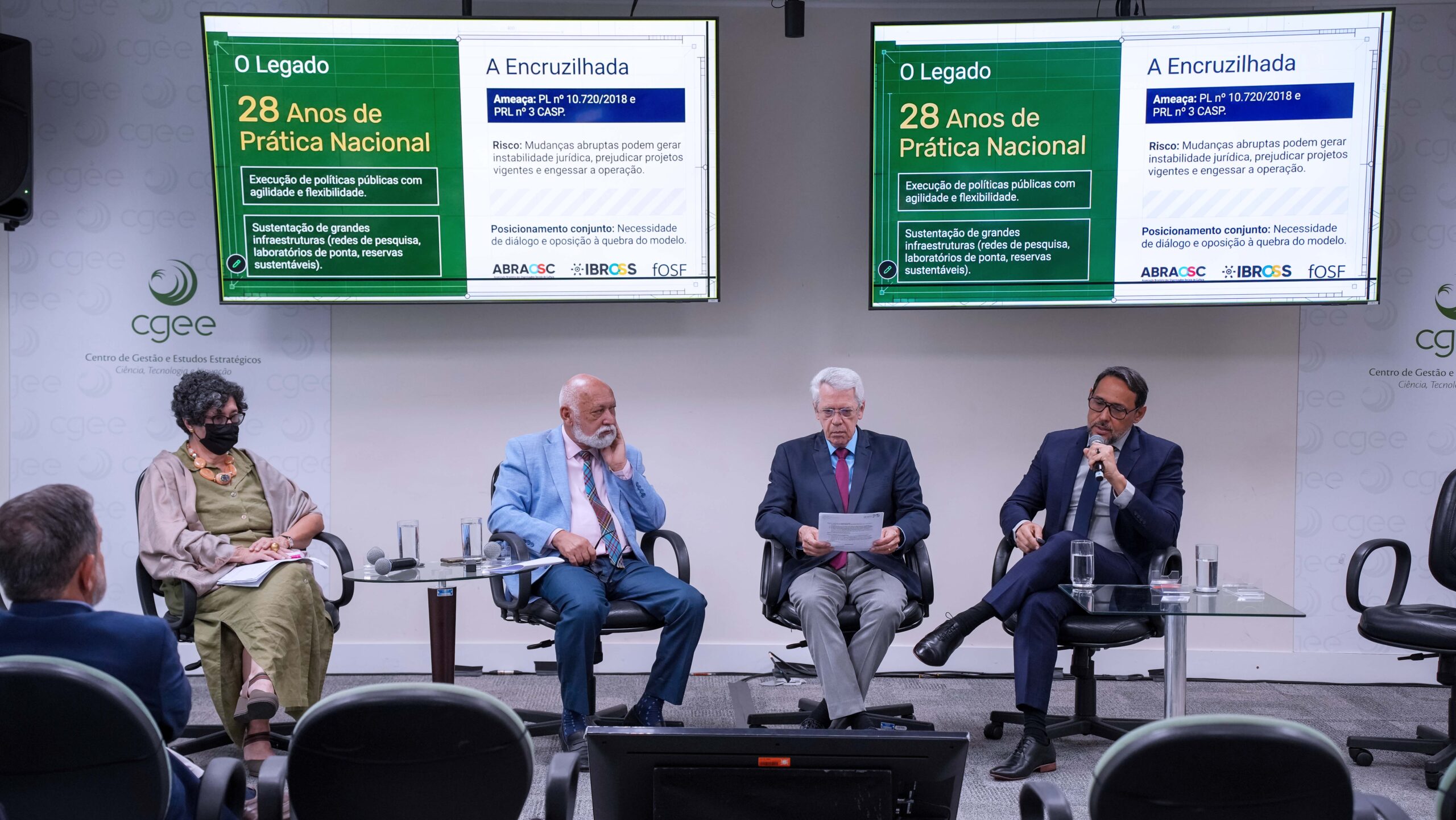
The Director-General of the Santos Dumont Institute (ISD), Reginaldo Freitas Júnior, participated last Tuesday (19) in the seminar “The Model of Social Organizations for the promotion of public policies: Current situation, lessons learned and paths for improvement”, promoted by the Center for Management and Strategic Studies (CGEE), in Brasília/DF. The meeting brought together representatives of the federal government, leaders of social organizations, specialists and former managers to discuss the advances, challenges and perspectives of the model in the National System of Science, Technology and Innovation (SNCTI).
The seminar, which is part of the CGEE's 25th anniversary celebrations, served as a qualified forum to analyze the impact of the Federal Social Organizations model in Brazil, an essential mechanism for the efficient execution of strategic state policies.
During the program, Reginaldo Freitas Júnior participated in the round table dedicated to the theme "Perspectives and paths for improvement for the model of social organizations". The debate also included contributions from Fernando Rizzo, former CEO of CGEE and professor at the Pontifical Catholic University of Rio de Janeiro (PUC-Rio); Anderson Gomes, current CEO of the Center; and Sheila Ribeiro, representative of the Ministry of Management and Innovation in Public Services (MGI).
The main objective of the panel was to outline pathways that strengthen the performance of these entities. Among the central topics discussed by the panelists were alternatives for regulatory improvement, strengthening governance models, increasing legal security for institutions, and improving mechanisms for the articulation, evaluation, and implementation of public policies executed through social organizations.
In his presentation, the Director-General of ISD emphasized the transformative role and historical relevance of federal Social Organizations in fostering the scientific and social development of the country. “Celebrating the 25th anniversary of CGEE with the proposal to bring together different intersectoral actors to discuss ways to improve and strengthen the Social Organization model for the promotion of public policies is very timely,” highlighted Reginaldo Freitas Júnior. “Today, strategic aspects of Brazil's development depend on the agility, effectiveness, and innovation made possible by this model, and it is indeed very necessary that it be widely known, discussed, and defended by the whole society.”
ISD's participation reinforces the importance of bringing together the spheres of public management, ministries, and institutions that work directly in the execution of these policies at the grassroots level, ensuring that the model continues to generate efficient and transparent results in the Brazilian science, technology, and innovation landscape.
About ISD
The Santos Dumont Institute (ISD) is a Social Organization of the Federal Executive Branch, supervised by the Ministry of Education, with the intervention of the Ministry of Sport. It encompasses the Edmond and Lily Safra International Institute of Neuroscience and the Anita Garibaldi Center for Education and Research in Health, both located in Macaíba. The ISD's mission is to promote education for life, forming citizens through integrated teaching, research, and outreach activities, as well as contributing to a more just and humane transformation of Brazilian social reality.